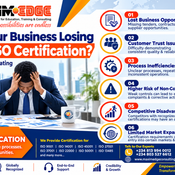


What Is Your Business Losing Without ISO Certification? 7 Hidden Risks That Could Be Limiting Your Growth
Discover how operating without ISO certification may affect business opportunities, customer trust, operational efficiency, and market access. Explore ISO certification consultancy services from MAXIMEDGE GROUP in Nigeria.
.
Introduction: Is Your Business Missing Opportunities Without Realising It?
Every business wants to win more contracts, attract reliable customers, improve profitability, and build a reputation that stands out in its industry. Yet, many organisations invest heavily in marketing, equipment, recruitment, and business development without paying sufficient attention to the management systems that support sustainable growth.
One important question every business owner, managing director, procurement manager, operations manager, and quality assurance professional should consider is this:
What is your business losing by operating without an effective management system and the relevant ISO certification?
The answer may extend beyond the cost of obtaining a certificate. Depending on your industry, customers, and contractual obligations, your organisation could be missing opportunities to qualify for tenders, demonstrate its commitment to quality, improve operational consistency, and establish confidence with prospective clients.
In today’s competitive business environment, ISO certification is an important consideration for organisations seeking to strengthen their processes, manage risks, demonstrate compliance, and improve their market position.
At MAXIMEDGE GROUP — Maximedge Technology & Consulting Limited, we support organisations with ISO consultancy, management system implementation, documentation, training, internal audit support, and preparation for independent certification audits.
Whether your organisation operates in oil and gas, construction, manufacturing, engineering, logistics, healthcare, ICT, food processing, or professional services, understanding the value of ISO certification is a practical step towards building a more resilient business.
Let’s examine seven potential business risks associated with operating without a structured management system.
1. Lost Business Opportunities, Tenders and Contracts
One of the most commercially significant risks for some businesses is the inability to meet a prospective client’s supplier qualification requirements.
Large corporations, government contractors, international organisations, and businesses operating in regulated or high-risk industries may require suppliers and contractors to demonstrate specific quality, environmental, occupational health and safety, information security, or other management system credentials.
Depending on the procurement requirements, an ISO certificate may be a mandatory qualification, a preferred credential, or one component of a broader supplier evaluation.
For example, a construction company pursuing a contract may encounter requirements relating to quality management and occupational health and safety. An oil and gas service provider may need to demonstrate that it has appropriate systems for managing operational risks, documentation, and service quality.
Without the required credentials or supporting management system, an otherwise capable business may struggle to qualify for certain opportunities.
How ISO certification can help
An appropriately selected and implemented ISO management system can help your organisation:
- Demonstrate conformity with relevant management system requirements.
- Strengthen supplier prequalification submissions.
- Improve the consistency of documented processes.
- Provide evidence of systematic risk management.
- Support customer and contractor evaluations where the relevant certification is required or recognised.
Important: ISO certification does not automatically guarantee contracts, tender eligibility, or business success. Each opportunity has its own requirements, and organisations should confirm the applicable criteria before investing in certification.
At MAXIMEDGE GROUP, we help businesses assess their requirements, identify suitable standards, and prepare for certification in line with their operational objectives and target markets.
2. Reduced Customer Trust and Confidence
Customers expect businesses to deliver products and services consistently. They want confidence that orders will be fulfilled correctly, complaints will be handled professionally, agreed specifications will be respected, and problems will be addressed.
When processes are informal, poorly documented, or inconsistently implemented, maintaining that confidence can become more difficult.
Consider a manufacturing business experiencing recurring product defects, a logistics provider struggling with service consistency, or a professional services firm receiving repeated complaints about delivery times. These problems can affect customer satisfaction and long-term relationships.
Although ISO certification alone cannot eliminate every operational problem, an effective management system provides a structured framework for managing responsibilities, monitoring performance, and improving processes.
How ISO 9001 can support customer confidence
ISO 9001 is the internationally recognised standard for quality management systems. It helps organisations establish processes for consistently providing products and services that meet customer and applicable statutory and regulatory requirements.
An effective ISO 9001 quality management system can support:
- Clearer definition of customer requirements.
- Consistent procedures and work instructions.
- Better control of errors and non-conforming outputs.
- Systematic handling of customer complaints.
- Performance monitoring and continual improvement.
For businesses seeking to strengthen their reputation, the combination of effective processes, satisfied customers, and credible certification can support a stronger commercial proposition.
MAXIMEDGE GROUP helps organisations understand ISO 9001 requirements and establish quality management systems that reflect their actual operations.
3. Process Inefficiencies, Repeated Work and Unnecessary Costs
How much time does your organisation lose because employees do not have clear procedures, departments work with inconsistent information, or tasks must be repeated due to preventable errors?
Operational inefficiencies are not always immediately visible in financial reports. They may appear as delays, excessive paperwork, duplicated activities, avoidable material waste, inconsistent service delivery, or frequent management intervention.
As businesses expand, informal methods that once seemed sufficient may become difficult to control.
Without clearly defined responsibilities and effective process controls, employees may perform the same task differently, important records may be difficult to retrieve, and management may struggle to identify the causes of recurring problems.
How a management system can improve efficiency
ISO management systems encourage organisations to identify, document where appropriate, monitor, and improve the processes that affect their performance.
Depending on the standard and the organisation’s needs, implementation may help to:
- Define responsibilities and authorities.
- Standardise critical operational processes.
- Improve document and record control.
- Identify process risks and opportunities.
- Establish measurable performance indicators.
- Reduce avoidable errors and repeated work.
- Make better use of resources.
The objective is not to create paperwork for its own sake. It is to establish controls that help people understand what needs to be done, how activities should be managed, and how performance can be improved.
At MAXIMEDGE GROUP, our ISO consultancy approach focuses on developing practical management systems that suit the organisation’s activities, size, risks, and business objectives.
4. Higher Risks of Non-Conformities, Complaints and Corrective Actions
A non-conformity occurs when a requirement has not been fulfilled. Depending on the circumstances, this may involve a customer specification, an internal procedure, a contractual obligation, or an applicable management system requirement.
When organisations lack effective controls, problems may go undetected until they result in customer complaints, failed inspections, audit findings, delays, rework, or other consequences.
For businesses operating in demanding environments, weak process controls can also undermine their ability to demonstrate compliance with applicable requirements.
How ISO management systems support risk control
Relevant ISO standards provide frameworks for identifying risks, establishing controls, monitoring performance, investigating problems, and taking corrective action.
For example:
- ISO 9001 addresses quality management and the control of non-conformities.
- ISO 14001 provides a framework for environmental management.
- ISO 45001 addresses occupational health and safety management.
- ISO 27001 addresses information security management.
An effective implementation should go beyond preparing manuals and procedures. Employees need to understand the system, management must provide appropriate resources, and the organisation must monitor whether its controls work as intended.
Certification audits can provide an independent assessment of conformity with the applicable standard. However, certification does not remove all business risks or replace legal compliance obligations.
MAXIMEDGE GROUP supports organisations with gap assessments, documentation, implementation guidance, internal audit preparation, and corrective action planning to help them prepare for independent certification.
5. Competitive Disadvantages in Your Industry
In competitive markets, customers frequently evaluate more than price. They may also consider service reliability, quality controls, safety performance, environmental responsibility, information security, and the supplier’s ability to meet contractual requirements.
When competing organisations can demonstrate relevant management system certification and your business cannot, you may find it more difficult to differentiate your organisation in opportunities where such credentials matter.
This is particularly relevant in sectors where customers operate formal procurement, supplier evaluation, or contractor management processes.
How ISO certification can strengthen your market position
Appropriate ISO certification can help your organisation demonstrate that its management system has been assessed against a recognised standard.
It may support your commercial positioning by helping you:
- Demonstrate commitment to defined management system requirements.
- Respond to customer requests for relevant certification evidence.
- Strengthen supplier and contractor qualification submissions.
- Support a more structured approach to quality, safety, environmental, or information security management.
- Build confidence among stakeholders who value independently assessed management systems.
Certification should be treated as part of a wider business strategy rather than a substitute for technical competence, competitive pricing, customer service, or sound financial management.
At MAXIMEDGE GROUP, we help businesses connect their ISO implementation objectives with their operational priorities and intended market opportunities.
6. Barriers to Entering Certain Markets and Supply Chains
Business expansion often requires organisations to demonstrate that their systems meet the expectations of new customers, industries, and markets.
A business that has successfully served local customers may encounter different supplier requirements when pursuing larger corporate contracts, international partnerships, or opportunities in highly regulated sectors.
Some prospective clients specify particular ISO standards, certification scopes, or certification bodies. Others may accept alternative evidence of conformity or use different evaluation criteria.
The relevant requirements must therefore be established before choosing a certification pathway.
Selecting the right ISO standard for your business
Different standards address different management system needs.
| ISO standard | Main focus | Potential relevance |
|---|---|---|
| ISO 9001 | Quality management | Manufacturers, contractors, service providers and suppliers |
| ISO 14001 | Environmental management | Businesses managing environmental aspects and impacts |
| ISO 45001 | Occupational health and safety | Organisations managing workplace health and safety risks |
| ISO/IEC 27001 | Information security | ICT firms, service providers and organisations managing information security risks |
| ISO 22000 | Food safety management | Organisations within the food chain |
| ISO 50001 | Energy management | Organisations seeking a structured approach to energy performance |
| ISO 37001 | Anti-bribery management | Organisations addressing bribery risks |
| ISO 22301 | Business continuity | Organisations planning for disruption and continuity of operations |
| ISO/IEC 42001 | Artificial intelligence management | Organisations developing, providing, or using AI systems within the standard’s scope |
The appropriate standard depends on your activities, risks, customer expectations, and applicable requirements. Some businesses may benefit from implementing an integrated management system covering multiple standards.
For example, an organisation may choose to integrate ISO 9001, ISO 14001, and ISO 45001 to manage quality, environmental, and occupational health and safety requirements within a coordinated framework.
MAXIMEDGE GROUP can help assess which standards are relevant to your organisation and develop a practical implementation roadmap.
7. Missed Opportunities for Organisational Learning and Continual Improvement
An organisation can continue operating for years without a formal management system. However, long-term growth becomes more challenging when management lacks reliable information about process performance, recurring problems, and improvement priorities.
A structured management system creates a framework for reviewing performance, gathering evidence, identifying weaknesses, assigning responsibilities, and monitoring corrective actions.
This can help management move away from repeatedly responding to the same problems and towards understanding why they occur.
The role of continual improvement
Depending on the standard, an effective management system may include:
- Defined business and management system objectives.
- Performance indicators and monitoring arrangements.
- Internal audits.
- Management reviews.
- Customer feedback and complaint analysis.
- Corrective action and root-cause analysis.
- Reviews of risks, opportunities, and changing business conditions.
These activities can help organisations make more informed decisions and strengthen accountability.
However, improvements are not automatic. They depend on leadership commitment, employee participation, adequate resources, and the effective implementation of the management system.
At MAXIMEDGE GROUP, we help organisations develop management systems that support practical implementation, performance monitoring, and continual improvement rather than certification documentation alone.
Which ISO Certification Is Right for Your Business?
Not every organisation needs the same ISO standard. Choosing a standard simply because competitors have it may lead to unnecessary expenditure or a system that does not adequately address your actual business needs.
A suitable starting point is to identify your operational risks, customer requirements, legal obligations, and growth objectives.
Here are some common starting points.
ISO 9001 — Quality Management System
ISO 9001 may be suitable for organisations seeking to improve process consistency, customer satisfaction, and quality management.
It is relevant to a wide range of industries, including manufacturing, construction, engineering, logistics, ICT, consulting, and other service sectors.
ISO 14001 — Environmental Management System
ISO 14001 provides a framework for managing environmental aspects, environmental risks, and related compliance obligations.
It may be relevant to manufacturers, construction companies, industrial facilities, contractors, and other organisations whose activities interact with the environment.
ISO 45001 — Occupational Health and Safety Management System
ISO 45001 helps organisations establish a systematic approach to managing occupational health and safety risks.
It may be particularly relevant to construction, oil and gas, engineering, manufacturing, maintenance, logistics, and other workplaces with significant occupational risks.
ISO 27001 — Information Security Management System
ISO/IEC 27001 provides requirements for an information security management system.
It may be relevant to technology companies, professional service providers, organisations handling sensitive information, and businesses whose clients require formal information security controls.
Integrated Management Systems
Where appropriate, organisations may integrate multiple management system standards into one coordinated framework.
An integrated management system can help align policies, objectives, risk management, documentation, audits, management reviews, and continual improvement activities.
For example, an integrated ISO 9001, ISO 14001, and ISO 45001 system may be useful for an organisation that needs coordinated quality, environmental, and occupational health and safety controls.
The right starting point is a review of your organisation’s requirements, not an assumption that every standard is necessary.
How MAXIMEDGE GROUP Can Support Your ISO Certification Journey
MAXIMEDGE GROUP, through Maximedge Technology & Consulting Limited, provides ISO consultancy and management system support to organisations seeking to strengthen compliance, improve processes, and prepare for certification.
Our support can be structured around your existing systems, business priorities, industry requirements, and desired certification scope.
Our ISO consultancy services include:
1. ISO gap assessment
We help review existing processes and management system arrangements against the requirements of the selected standard to identify areas requiring attention.
2. ISO implementation consultancy
We provide guidance on establishing and implementing a management system appropriate to your organisation’s activities and risks.
3. ISO documentation support
We assist with developing or improving relevant policies, procedures, process documentation, forms, registers, and other documented information required by the applicable system.
4. ISO awareness and implementation training
We support employees and management in understanding their responsibilities and the requirements of the management system.
5. Internal audit support
We assist organisations in preparing internal audit programmes, evaluating conformity, documenting findings, and following up corrective actions.
6. Management review and certification readiness
We help organisations review implementation progress, address identified gaps, and prepare for an independent certification audit.
7. Certification pathway guidance
We help clients understand the steps involved in pursuing certification and the importance of selecting an appropriate certification body.
Certification is granted by the relevant independent certification body following its assessment and decision process. MAXIMEDGE’s consultancy support does not itself constitute the award of an ISO certificate or guarantee a successful certification outcome.
Our Approach: Practical Systems, Not Just Paperwork
One of the common mistakes organisations make is treating ISO certification as a document-production exercise.
A collection of manuals and procedures cannot deliver the full value of a management system if employees do not understand them, processes are not implemented, and management does not monitor performance.
A successful implementation should reflect how the organisation actually operates.
Our approach is designed to help clients work through key stages, including:
- Initial consultation: Understand your organisation, operations, objectives, and certification requirements.
- Standards selection: Identify the relevant standard or combination of standards.
- Gap assessment: Review existing arrangements and identify implementation priorities.
- System development: Establish appropriate policies, procedures, controls, and documented information.
- Implementation and training: Support employees and management in applying the system.
- Internal audit and corrective action: Evaluate conformity and address identified gaps.
- Certification audit preparation: Prepare for assessment by the selected independent certification body.
The actual duration and scope depend on factors such as organisational size, complexity, existing systems, available resources, and the standard being implemented.
Why Choose MAXIMEDGE GROUP for ISO Consultancy in Nigeria?
Selecting an ISO consultant is an important business decision. Organisations should look for a provider that understands management system requirements and can explain how implementation relates to day-to-day operations.
MAXIMEDGE GROUP offers consultancy, training, and management system support to organisations seeking a structured approach to ISO implementation and certification readiness.
Our service approach emphasises:
- Business-focused guidance: Aligning management system objectives with your organisation’s operational and commercial needs.
- Practical documentation: Developing documented information relevant to your processes and applicable requirements.
- Implementation support: Helping your team understand and apply the management system.
- Training and awareness: Supporting management and employees in understanding their roles.
- Audit readiness: Helping identify gaps and prepare for independent assessment.
- Flexible engagement: Discussing the scope of work based on your organisation’s needs.
We serve organisations seeking ISO consultancy support in Port Harcourt, Lagos, Abuja, Warri, Uyo, and other locations across Nigeria, subject to agreed delivery arrangements.
Whether your business is pursuing its first certification or seeking to improve an existing management system, we encourage you to begin with a discussion of your requirements.
Frequently Asked Questions About ISO Certification
1. Is ISO certification compulsory for every business in Nigeria?
No. ISO certification is not universally compulsory for every business. However, particular clients, contracts, procurement processes, industries, or regulatory frameworks may impose specific requirements. Businesses should confirm the obligations applicable to their operations and target opportunities.
2. Can ISO certification help my business win tenders?
It can help where the relevant certification is required, recognised, or considered in supplier qualification. However, certification does not guarantee tender eligibility or contract awards. You must satisfy the other applicable technical, commercial, financial, legal, and procurement requirements.
3. How much does ISO certification cost in Nigeria?
The cost depends on the standard, scope, organisation size, operational complexity, existing management system, consultancy requirements, and certification body’s audit and certification fees.
MAXIMEDGE GROUP recommends an initial scoping discussion to understand your requirements and determine an appropriate proposal.
4. How long does it take to obtain ISO certification?
There is no universal timeline. The time required depends on the organisation’s readiness, the standard selected, the complexity of its processes, implementation progress, and the certification body’s assessment arrangements.
A realistic timeline should be established after reviewing the organisation’s circumstances.
5. Can a business implement more than one ISO standard?
Yes. An organisation may implement multiple management system standards and, where appropriate, integrate their common requirements. The selected standards should reflect the organisation’s activities, risks, customer requirements, and business objectives.
6. Does MAXIMEDGE GROUP issue ISO certificates?
MAXIMEDGE GROUP provides consultancy, training, management system implementation support, and certification readiness assistance. The ISO certificate is issued by the relevant independent certification body following its assessment and certification decision.
Before engaging any provider, organisations should verify the certification body’s competence, accreditation status where relevant, and acceptance within their intended market or contractual requirements.
7. Where can I request ISO certification consultancy?
You can submit your requirements through the MAXIMEDGE GROUP ISO Certification Request Form:
Our team can then discuss your needs and the next steps towards defining a suitable scope of work.
Conclusion: Do Not Let Preventable Management Gaps Limit Your Business
Without an effective management system, organisations may face avoidable inefficiencies, inconsistent service delivery, difficulty demonstrating conformity, and challenges meeting certain customer or supplier qualification requirements.
ISO certification is not a magic solution, and a certificate alone cannot guarantee profitability, customer loyalty, regulatory compliance, or contract awards. Its value depends on selecting an appropriate standard, implementing the system effectively, and maintaining it over time.
For businesses seeking to strengthen operational control, improve credibility, and prepare for new opportunities, ISO implementation can be a worthwhile strategic investment.
The first step is to understand where your organisation stands today and what its customers, contracts, and business objectives require.
Ready to Strengthen Your Business with ISO Certification?
Let MAXIMEDGE GROUP help you identify the right ISO certification pathway for your organisation.
Request an assessment or scoping discussion today.
ISO Certification Request Form:
https://maximedgeconsulting.com/ISO-Certification-Request-Form.html
Website: https://www.maximedgeconsulting.com
Telephone: +234 813 994 0012 | +234 803 527 6612
Email: maximedgeconsulting@gmail.com
Office: No. 1 Eze Gbakagbaka Road, beside Chelsea Filling Station, Woji, Port Harcourt, Rivers State, Nigeria.
MAXIMEDGE GROUP
Professional Services • Consulting • Training • Technology • Business Solutions
Empowering Growth. Ensuring Compliance. Transforming Operations.
Take the next step towards a more structured, credible, and resilient business. Contact MAXIMEDGE GROUP to discuss your ISO consultancy requirements.