
How to Become ISO Certified in Nigeria: A Complete Step-by-Step Guide for Companies
ISO certification is becoming increasingly important for Nigerian businesses that want to demonstrate professionalism, improve operational performance, satisfy customer requirements and compete for larger contracts and business opportunities.
Whether you operate in Oil & Gas, Construction, Manufacturing, Engineering, Healthcare, Logistics, Food & Beverage, ICT, Consulting, Education, Agriculture, Banking or other sectors, implementing an appropriate ISO management system can provide a structured framework for managing your business.
But how exactly does a company become ISO certified in Nigeria?
What documents are required?
How long does the process take?
Do you need a consultant?
Who issues the ISO certificate?
And what happens after certification?
This guide explains the process step by step.
What Is ISO Certification?
ISO certification is an independent assessment that confirms an organization’s management system conforms to the requirements of a particular ISO standard.
Common examples include:
- ISO 9001 – Quality Management System
- ISO 14001 – Environmental Management System
- ISO 45001 – Occupational Health & Safety Management System
- ISO 22000 – Food Safety Management System
- ISO 27001 – Information Security Management System
- ISO 50001 – Energy Management System
- ISO 37001 – Anti-Bribery Management System
- ISO 22301 – Business Continuity Management System
- ISO 13485 – Medical Devices Quality Management System
The appropriate standard depends on the organization’s activities, risks, customers and business objectives.
An important distinction is that ISO develops and publishes standards but does not itself perform certification. Certification is carried out by independent certification bodies.
Why Are Nigerian Companies Pursuing ISO Certification?
ISO certification can be relevant for organizations seeking to strengthen their management systems and demonstrate conformity to recognized requirements.
Businesses may pursue certification because of:
1. Customer Requirements
Large companies and multinational organizations may require suppliers and contractors to demonstrate conformity with particular management system standards.
2. Tender and Contract Requirements
Some tenders and procurement opportunities may specify ISO certification or equivalent management-system requirements.
3. Improved Business Processes
ISO implementation encourages organizations to define, control, monitor and continually improve their processes.
4. Risk Management
Standards such as ISO 45001 and ISO 14001 provide structured approaches to identifying and controlling occupational health, safety and environmental risks.
5. Customer Confidence
Certification can provide independent evidence that an organization’s management system has been assessed against specified requirements.
6. Business Growth
A structured management system can become increasingly valuable as a company expands its workforce, operations, locations and customer base.
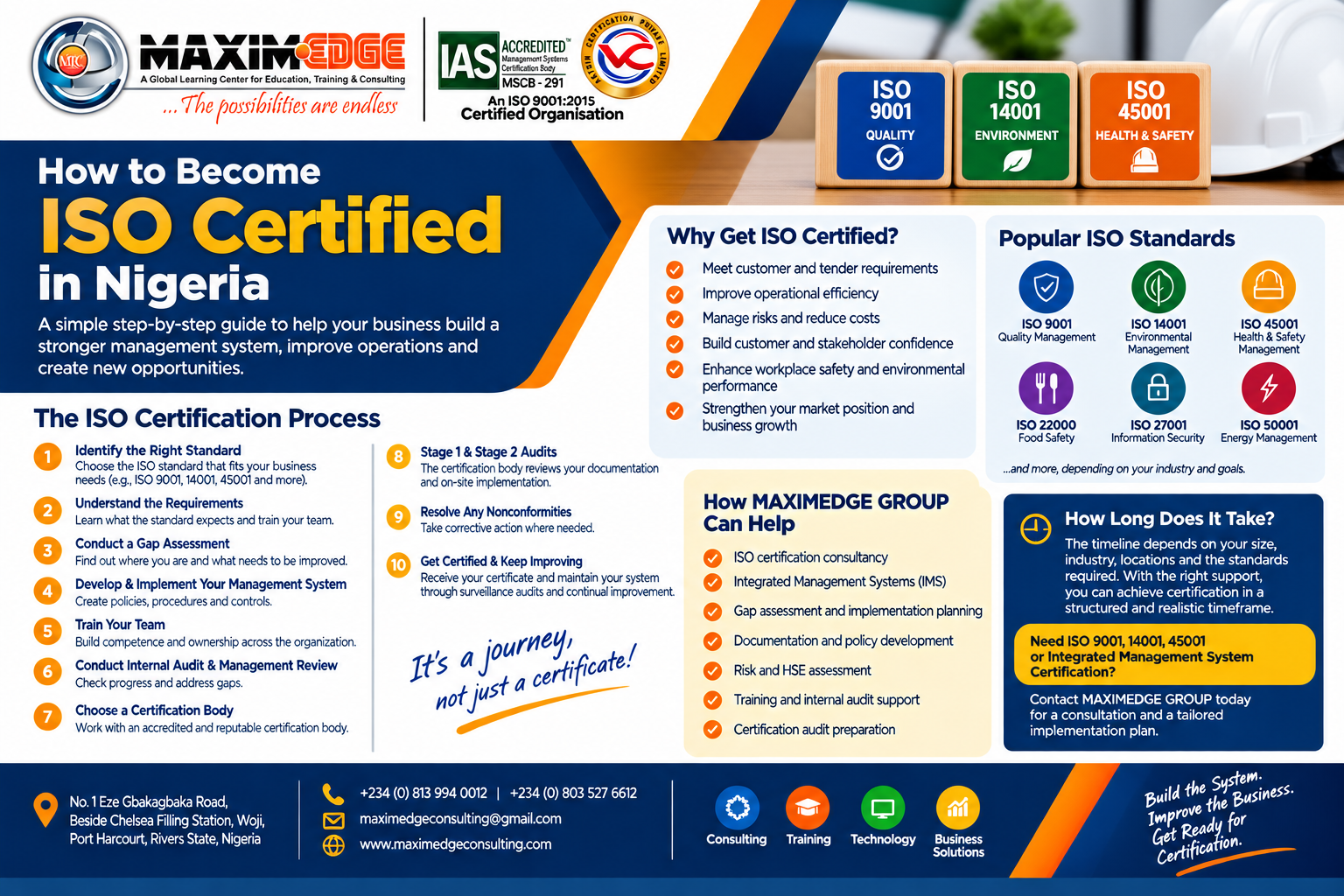
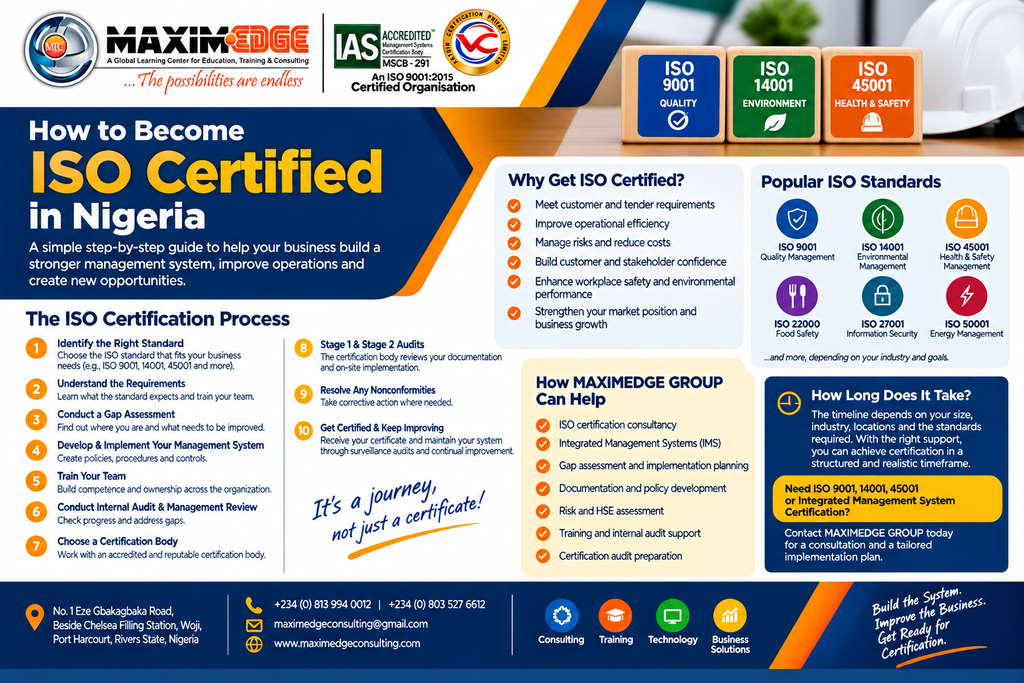
Step 1: Determine Which ISO Standard Your Company Needs
The first step is to identify the standard that matches your organization’s objectives and activities.
For example:
| Business Need | Relevant ISO Standard |
|---|---|
| Quality management | ISO 9001 |
| Environmental management | ISO 14001 |
| Occupational health & safety | ISO 45001 |
| Food safety | ISO 22000 |
| Information security | ISO/IEC 27001 |
| Energy management | ISO 50001 |
| Business continuity | ISO 22301 |
| Anti-bribery management | ISO 37001 |
| Medical devices | ISO 13485 |
Some organizations may require more than one standard.
For example, a construction or engineering company may decide to implement:
ISO 9001 + ISO 14001 + ISO 45001
This can be managed as an Integrated Management System (IMS) rather than treating the three systems as completely separate projects.
The Standards Organisation of Nigeria (SON) lists ISO 9001, ISO 14001, ISO 45001, ISO 22000 and Integrated Management System among its management-system certification services.
Step 2: Understand the Requirements of the Standard
Before beginning implementation, management and relevant employees should understand what the selected ISO standard requires.
For example, ISO 9001 focuses on areas such as:
- Organizational context
- Leadership
- Planning
- Risk and opportunities
- Support
- Operational control
- Performance evaluation
- Improvement
ISO 45001 introduces requirements relating to occupational health and safety, while ISO 14001 focuses on environmental management.
Training can therefore be useful at the beginning of the project.
Typical training may include:
- ISO Awareness Training
- ISO Implementation Training
- Internal Auditor Training
- Lead Auditor Training
- Management Systems Training
Step 3: Conduct a Gap Assessment
One of the most important stages is determining where your organization currently stands compared with the requirements of the standard.
This is known as a gap assessment or gap analysis.
The assessment examines areas such as:
- Existing policies
- Organizational structure
- Business processes
- Responsibilities and authorities
- Existing documentation
- Risk management
- Operational controls
- Records
- Performance monitoring
- Internal audits
- Management reviews
- Corrective actions
- Legal and regulatory requirements
The outcome should identify:
What you already have → What is missing → What needs improvement → What needs to be implemented.
This provides a roadmap for the certification project.
Step 4: Develop the Required Management System
After the gap assessment, the organization begins developing or improving its management system.
Depending on the standard and organization, this may include:
Policies
Examples include:
- Quality Policy
- Environmental Policy
- Health & Safety Policy
- Information Security Policy
- Other applicable policies
Procedures
Procedures define how important organizational activities are controlled.
Work Instructions
These provide more detailed instructions for specific activities where necessary.
Forms and Records
Records provide evidence that required activities have actually been performed.
Examples include:
- Inspection records
- Training records
- Audit reports
- Risk assessments
- Corrective action records
- Equipment maintenance records
- Supplier evaluations
- Meeting minutes
- Incident reports
However, ISO implementation should not become a documentation exercise alone.
The organization must actually implement the system and retain appropriate evidence that its processes are being followed.
SON describes its certification route as including establishing documented information, implementing the management system, maintaining records, conducting internal audits and measuring system effectiveness.
Step 5: Implement the Management System
This is where the documented system becomes part of the organization’s daily operations.
Employees must understand their responsibilities and follow the applicable processes.
For example, an ISO 9001 implementation may require the organization to demonstrate how it:
- Receives customer requirements
- Reviews contracts
- Controls purchasing
- Evaluates suppliers
- Performs its services
- Controls nonconforming outputs
- Handles customer complaints
- Monitors performance
- Maintains records
- Implements corrective actions
For ISO 45001, the organization would also need to systematically manage occupational health and safety risks.
For ISO 14001, environmental aspects and impacts need to be identified and managed appropriately.
Implementation is what separates a functioning management system from a collection of documents.
Step 6: Train Internal Auditors
Your organization should have competent personnel capable of conducting internal audits.
Internal auditors examine whether the management system:
- Meets the requirements of the applicable ISO standard;
- Meets the organization’s own procedures and requirements; and
- Is effectively implemented and maintained.
Internal Auditor Training can help employees understand:
- Audit principles
- Audit planning
- Audit checklists
- Interview techniques
- Evidence gathering
- Nonconformity identification
- Audit reporting
- Corrective action follow-up
SON’s published certification route specifically includes internal auditor training as part of preparing an organization for management-system certification.
Step 7: Conduct an Internal Audit
Before inviting the external certification body to conduct the certification audit, the organization should conduct an internal audit.
The internal audit should cover the relevant processes and requirements within the defined certification scope.
The objective is not to “pass an audit.”
The objective is to discover problems before the external certification audit does.
Potential findings may include:
- Missing records
- Inconsistent procedures
- Uncontrolled documents
- Incomplete risk assessments
- Inadequate monitoring
- Unresolved customer complaints
- Training gaps
- Safety deficiencies
- Environmental control gaps
These findings should be properly addressed.
Step 8: Conduct Management Review
Top management should review the performance and effectiveness of the management system.
Depending on the standard, management review may consider issues such as:
- Audit results
- Customer feedback
- Process performance
- Objectives
- Risks and opportunities
- Nonconformities
- Corrective actions
- Resource requirements
- Changes affecting the organization
- Opportunities for improvement
This demonstrates that the management system is being actively managed by leadership.
Step 9: Select an Appropriate Certification Body
This is one of the most important decisions in the certification process.
A consultant helps an organization prepare and implement its management system.
The certification body performs the independent certification audit.
These roles should not be confused.
When selecting a certification body, organizations should examine:
- The certification body’s competence
- Applicable accreditation
- Accreditation scope
- Relevant industry competence
- Certification standard covered
- Geographic coverage
- Audit arrangements
- Certification costs
- Surveillance arrangements
- Recognition requirements of important customers or tendering organizations
SON’s Management Systems Certification Department states that its certification activities operate in line with ISO/IEC 17021 requirements and that its management-system certification services include accredited certification for standards such as ISO 9001, ISO 14001 and ISO 45001.
Step 10: Certification Audit – Stage 1
The certification process generally begins with an initial audit.
SON describes Stage 1 as primarily involving a review of documentation and an assessment of the organization’s readiness for the implementation audit.
The auditor may examine areas such as:
- Management system documentation
- Certification scope
- Organizational context
- Processes
- Applicable requirements
- Internal audit arrangements
- Management review
- Readiness for Stage 2
Any issues identified should be addressed appropriately before proceeding.
Step 11: Certification Audit – Stage 2
Stage 2 is the main certification audit.
The auditors evaluate whether the organization’s management system has been effectively implemented and conforms to the applicable standard.
Auditors may:
- Interview employees
- Review records
- Observe activities
- Examine processes
- Verify controls
- Review evidence
- Evaluate implementation
- Identify nonconformities where applicable
The organization must demonstrate that the management system is not merely documented but is actually operating.
Step 12: Correct Nonconformities
If the certification audit identifies nonconformities, the organization may need to:
Identify the problem → Determine the cause → Take corrective action → Provide evidence → Allow the certification body to evaluate the response.
The specific process and timelines depend on the certification body’s procedures and the nature of the findings.
Do not view audit findings as simply a failure.
A properly managed corrective-action process is part of continual improvement.
Step 13: Certification Decision
After the certification audit and resolution/evaluation of applicable findings, the certification body makes a certification decision through its established independent process.
If the organization meets the applicable certification requirements, the certification body issues the certificate.
SON similarly describes a certification decision following the audit process and issuance of the certificate where successful.
Step 14: Maintain Your ISO Certification
Getting certified is not the end of the process.
The management system must continue to operate effectively.
Certification bodies conduct surveillance activities during the certification cycle.
SON states that its certification route includes yearly surveillance audits and a recertification audit every three years.
Therefore, companies should continue to:
- Conduct internal audits
- Hold management reviews
- Monitor objectives
- Maintain records
- Manage risks
- Address nonconformities
- Improve processes
- Keep employees competent
- Update documentation when necessary
How Long Does ISO Certification Take in Nigeria?
There is no single timeline that applies to every organization.
The duration depends on factors such as:
- Company size
- Number of employees
- Number of locations
- Complexity of operations
- Certification scope
- Existing management systems
- Number of standards
- Availability of records
- Employee readiness
- Level of management commitment
- Audit requirements
A small organization with an existing mature management system may progress considerably faster than a large organization starting from scratch.
For an Integrated Management System such as:
ISO 9001 + ISO 14001 + ISO 45001
the implementation programme should be properly planned so that the three standards are integrated rather than unnecessarily duplicated.
Do You Need an ISO Consultant?
Not necessarily.
An organization can develop and implement its management system internally if it has the necessary competence, resources and time.
However, many organizations engage consultants because they need assistance with:
- Gap assessment
- Implementation planning
- Documentation
- Risk assessment
- Process development
- Training
- Internal auditing
- Corrective action
- Certification audit preparation
A consultant should help the organization develop a system that reflects its actual business operations.
The consultant should not replace management ownership of the system.
How Much Does ISO Certification Cost in Nigeria?
There is no universal ISO certification price.
The total cost can depend on:
- Standard selected
- Company size
- Number of employees
- Number of locations
- Complexity of operations
- Certification scope
- Certification body
- Audit duration
- Consultancy requirements
- Training requirements
- Documentation requirements
- Travel and accommodation requirements
- Number of standards
For this reason, a reputable provider should assess the organization’s requirements before giving a meaningful quotation.
Be cautious of advertisements promising an ISO certificate for an unrealistically low fixed price without any meaningful assessment, implementation or audit.
A genuine management-system certification process involves assessment and evidence of conformity.
Can a Company Get ISO 9001, ISO 14001 and ISO 45001 Together?
Yes.
Organizations whose operations make all three standards relevant can implement them as an Integrated Management System (IMS).
The three standards can be coordinated around common management-system elements while maintaining the specific requirements of each standard.
For example:
ISO 9001
Focuses on quality and customer requirements.
ISO 14001
Focuses on environmental management.
ISO 45001
Focuses on occupational health and safety.
An integrated system can help reduce unnecessary duplication in areas such as:
- Document control
- Internal audits
- Management review
- Corrective action
- Objectives
- Risk-based planning
- Training
- Continual improvement
SON also lists Integrated Management System among its management-system certification services.
Common Mistakes Nigerian Companies Make When Pursuing ISO Certification
Mistake 1: Buying a Certificate Without Implementing a System
ISO certification is not simply a document purchase.
The organization needs an implemented management system that meets the applicable requirements.
Mistake 2: Creating Documents Nobody Uses
A 200-page manual does not automatically mean a company has an effective management system.
Documentation should support the organization’s actual processes.
Mistake 3: Leaving Everything to the Consultant
Management and employees must own the system.
Mistake 4: Waiting Until the Audit Before Taking Implementation Seriously
Certification preparation should begin well before the external audit.
Mistake 5: Ignoring Internal Audits
Internal audits provide an opportunity to identify weaknesses before the certification audit.
Mistake 6: Choosing a Certification Body Without Checking Its Credentials
Always examine the certification body’s competence, scope and applicable accreditation/recognition requirements.
A Practical ISO Certification Roadmap for Nigerian Companies
A simple roadmap can look like this:
1. Identify the appropriate ISO standard
↓
2. Define the certification scope
↓
3. Conduct a gap assessment
↓
4. Develop the implementation plan
↓
5. Develop/update management-system documentation
↓
6. Train relevant personnel
↓
7. Implement the management system
↓
8. Generate and maintain records
↓
9. Conduct internal audit
↓
10. Conduct management review
↓
11. Correct identified issues
↓
12. Select certification body
↓
13. Stage 1 certification audit
↓
14. Stage 2 certification audit
↓
15. Address applicable nonconformities
↓
16. Certification decision
↓
17. Maintain and continually improve the system
How MAXIMEDGE GROUP Can Help Your Organization
At MAXIMEDGE GROUP, we support organizations seeking to develop, implement and prepare for certification against applicable management-system standards.
Our services can include:
ISO Certification Consultancy
- ISO 9001
- ISO 14001
- ISO 45001
- ISO 22000
- ISO 27001
- ISO 37001
- ISO 50001
- ISO 22301
- ISO 13485
- Other applicable management-system standards
Integrated Management Systems
We can support organizations implementing:
ISO 9001 + ISO 14001 + ISO 45001
as an integrated management system.
Our Support Can Include
- Gap assessment
- Implementation planning
- ISO documentation
- Policies and procedures
- Risk assessment
- Environmental aspects and impacts
- HSE risk assessment
- Internal auditor training
- Internal audit support
- Management review support
- Corrective action
- Certification audit preparation
We work with organizations seeking structured management systems that are aligned with their actual business activities.
Ready to Start Your ISO Certification Journey?
Whether you are pursuing ISO certification because of a tender requirement, customer requirement, business expansion, operational improvement, corporate credibility or international market objectives, the right approach is to start with a proper assessment of your organization’s current position.
Don’t start by asking, “How do I get the certificate?”
Start by asking:
“What management system does my organization need, and how can we implement it effectively?”
That is where sustainable ISO certification begins.
Start Your ISO Certification Project with MAXIMEDGE GROUP
MAXIMEDGE GROUP
Consulting • Training • Technology • Business Solutions
ISO Certification & Management Systems | QHSE & Sustainability | Training & Professional Development | Business & HR Solutions
📍 No. 1 Eze Gbakagbaka Road, Beside Chelsea Filling Station, Woji, Port Harcourt, Rivers State, Nigeria
📞 +234 (0) 813 994 0012 | +234 (0) 803 527 6612
📧 maximedgeconsulting@gmail.com
🌐 www.maximedgeconsulting.com
Need ISO 9001, ISO 14001, ISO 45001 or Integrated Management System Certification?
Contact MAXIMEDGE GROUP today to request an ISO certification assessment and implementation proposal.
Build the System. Improve the Business. Get Ready for Certification.
ISO certification in Nigeria, ISO consultant in Nigeria, ISO certification consultant Nigeria, ISO 9001 certification Nigeria, ISO 14001 certification Nigeria, ISO 45001 certification Nigeria, IMS certification Nigeria, integrated management system Nigeria, ISO implementation Nigeria, ISO consultancy Port Harcourt, ISO consultant Port Harcourt, ISO certification Lagos, ISO certification Abuja, how to become ISO certified in Nigeria